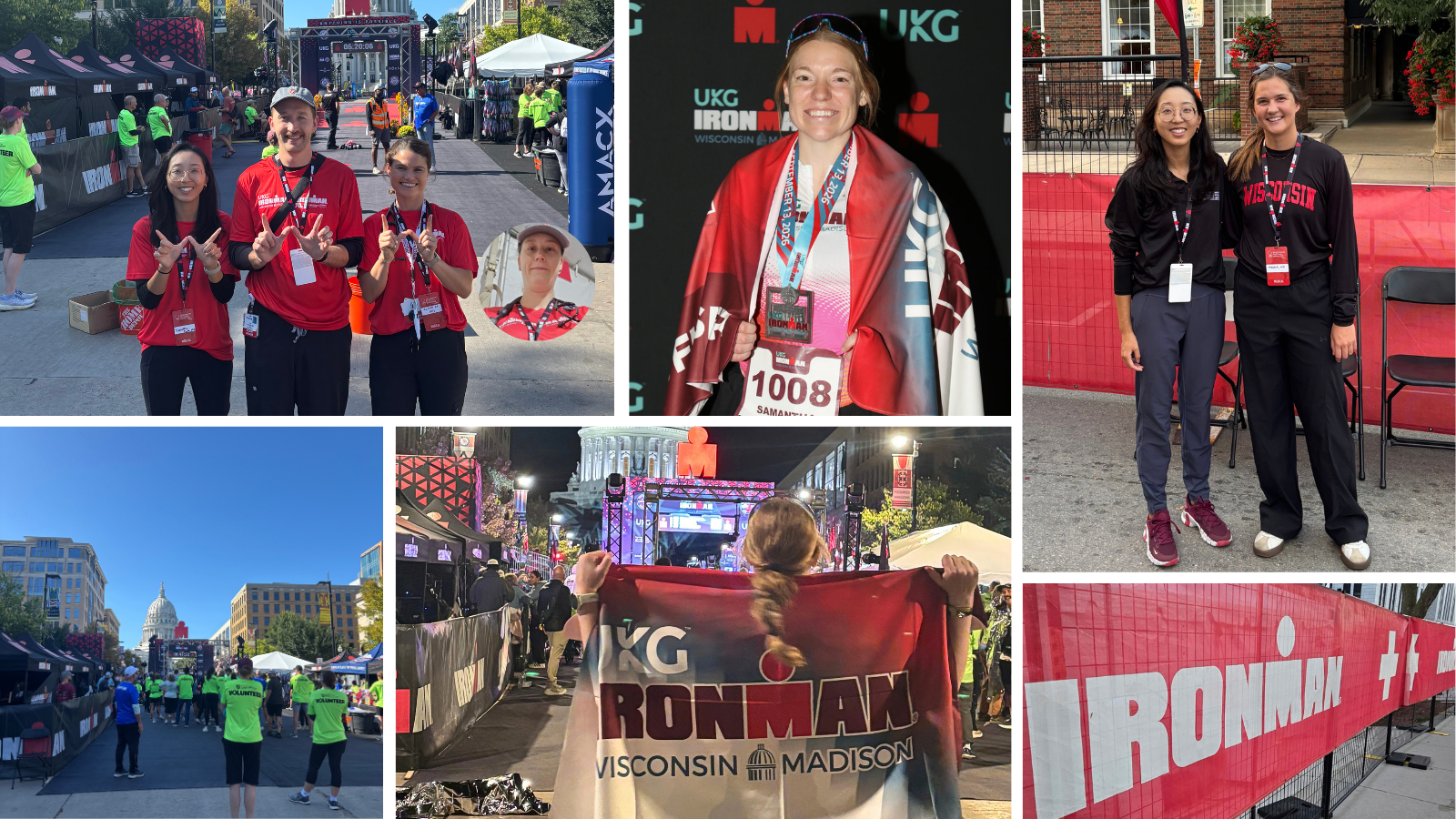
Six UW emergency medicine residents took part in the 2026 Ironman Wisconsin weekend, experiencing the endurance competition both on and off the race course.
Dr. Samantha Crowley, a second-year resident and alumna of UW–Madison and the UW School of Medicine and Public Health, completed her first full Ironman, covering 140.6 miles in 15 hours, 59 minutes and 25 seconds. Five residents representing all three postgraduate years volunteered with the event medical team.
Ironman Wisconsin featured a 70.3-mile triathlon on Sept. 12 and the full 140.6-mile race on Sept. 13.
Together, their experiences reflect the stamina and discipline demanded by both endurance sport and emergency medicine — and a residency that gives trainees room to test their limits, explore career pathways and sustain the well-being to do both.
Training for the hospital and the hills
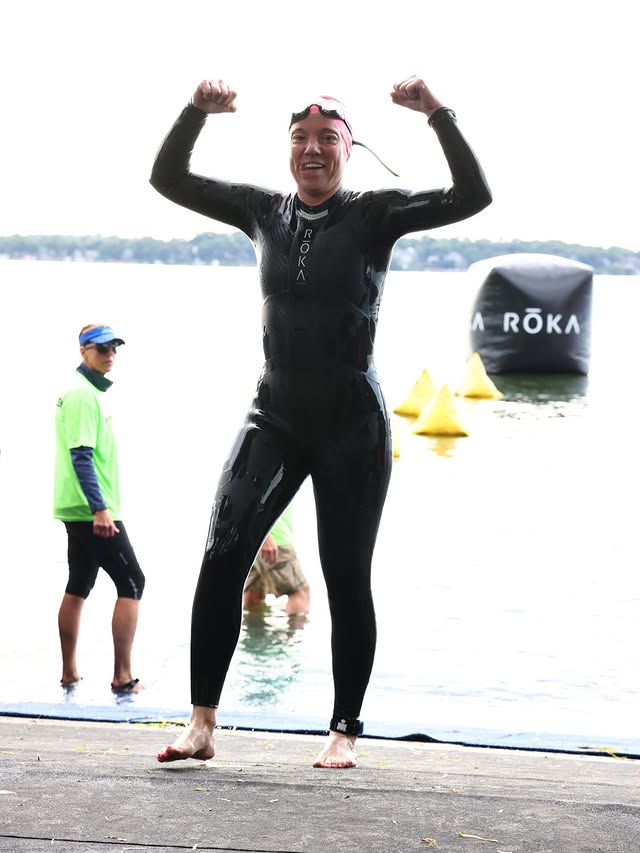
For Crowley, crossing the finish line capped years of endurance events and reflected a mindset she also brings to residency training. “Thinking you can is 90% of the battle,” Crowley said. “Getting comfortable being uncomfortable because that’s where you grow.”
Crowley has run marathons and completed shorter triathlons for years, often alongside her family. She finished a 70.3-mile Ironman in Indiana with her dad last year and marathons in Nevada, Salt Lake City and Austin with her mom earlier this year.
Crowley made her first attempt at a full Ironman in 2024. She completed the swim and reached mile 105 of the bike before narrowly missing the course cutoff. She was disappointed but left knowing how close she had come. “I knew I could finish it one day,” she said.
Two years later, her dad was already registered for Ironman Wisconsin and convinced her to join him.
Training for a full Ironman race — a 2.4-mile swim, 112-mile bike ride and 26.2-mile run — during residency required flexibility. Crowley skipped a formal program, running when she could during the week and fitting in long bike rides with her dad when she had a Sunday off shift. A free weekend might become a chance to enter another marathon.
“Residency and life is kind of hard to schedule training around,” she said. “I would probably be faster if I followed a formal plan, but I enjoy it more this way.”
Crowley says she is drawn to the challenge, the people she shares it with and the chance to keep learning, a mindset she carries into residency training. “Knowing you’ll never be good at something the first time you try it,” she said. “Give yourself grace to be bad at things and learn from it.”
When a challenge feels overwhelming, she makes it smaller. “Take big challenges in small bites,” Crowley said. “Just focus on making it to the next mile…and then do that again and again.”
Race day gave her plenty of chances to practice that philosophy.
Crowley walked to the swim start with her dad and backstroked the entire 2.4 miles. At one point, she spotted a cloud that looked suspiciously like a kidney on ultrasound. Her clinical assessment from Lake Monona: “no hydronephrosis.”
The 112-mile bike course was less forgiving. “The hills kept coming and they did not stop,” she said. Rather than dwell on how much road remained, Crowley focused on the next marker: mile 50, then 55, then the next one.
“Thinking you can is 90% of the battle.”
–Samantha Crowley, MD, MPH, PGY-2 resident
By the marathon — her favorite of the three disciplines — the mood shifted. Darkness fell, but spectators still lined the course, building energy around athletes approaching the end of a long day.
Nearly 16 hours into the race, Crowley reached the final stretch to a burst of energy from family and friends — jumping, waving, shouting and running alongside her as she closed in on the finish line. Also waiting was fellow resident Dr. Dorothy Chan, who was volunteering with the medical team and captured Crowley’s finish on video.
Medicine on the other side of the finish line
Chan was among five UW emergency medicine residents volunteering with the medical team, joining Drs. Madison Nikolai, Finn McGarghan, Alana Moore and Chelsea Seelbinder.
Ironman medical teams care for athletes who become ill or injured during and after the race. Physician volunteers evaluate concerns such as dehydration, electrolyte imbalances, exhaustion and injuries, provide or coordinate treatment, and determine when a higher level of care is needed. Most medical-tent visits occur after athletes cross the finish line.
For Chan, a third-year resident, and Nikolai, a first-year resident, volunteering offered another way to explore the intersection of emergency, sports and event medicine.
Now in her second year as an Ironman volunteer, Chan said supporting athletes and serving the local community has been meaningful, both personally and professionally. “As someone interested in sports medicine and event medicine, it’s been a great opportunity to combine two things I love,” she said.
For Nikolai, the experience was memorable for both the athletes’ resilience and the chance to see more closely what it means to care for them in a unique, out-of-hospital setting. “Seeing people push through the physical and mental demands of an Ironman while still showing so much gratitude, determination and positivity was inspiring,” she said. “It’s a great reminder of the strength of the human spirit and one of the many reasons I love working with athletes.”
Events like Ironman also make Madison part of the training environment. Residents can apply emergency medicine skills beyond the hospital, learn alongside clinicians caring for athletes and spectators in the field and explore potential career paths in sports and prehospital medicine.
For Crowley, the weekend brought the two worlds together another way. She had finished a month-long rotation in the intensive care unit just one day before stepping to the starting line. Her approach to both was much the same.
“One foot in front of the other,” she said, “and eventually you’ll make it there.”
Visit residency.emed.wisc.edu to learn more about the accredited emergency medicine residency and fellowship programs at the University of Wisconsin Hospitals and Clinics.