
We are dedicated to advancing emergency medicine through rigorous research and discovery, comprehensive physician training, and compassionate patient care.
You can’t stop a Badger…
Because we Badgers are born with curious minds and endless heart. For more than 175 years, the University of Wisconsin–Madison’s life-changing research, innovation, and education has served generations of Wisconsin families. We’ll never stop working to make our state — and the world — a better place.
Since our founding in 2014, the BerbeeWalsh Department of Emergency Medicine has become a nationally recognized, top-tier academic department of emergency medicine of over 60 core faculty and 25 advanced practice providers who are deeply committed to identifying and addressing obstacles to health and to fostering belonging in all aspects of our work.
We deliver exceptional health care to patients from across the upper Midwest through state-of-the-art clinical facilities and services and robust clinical programs including critical care, ultrasound, and prehospital medicine.
Training the next generation of emergency physicians and clinician-scientists is integral to our mission, with more than 50 residents and fellows training each year through our ACGME-accredited residency program and ten fellowship training programs.
Our research enterprise enhances and facilitates high-impact clinical and translational emergency care research and fosters the successful development of investigators dedicated to the pursuit of knowledge, excellence, equity, and real-world impact.
To learn more about our department, we invite you to read a message from our distinguished Chair and to visit our education, research, clinical care, and academic divisions pages.
Key Facts
Established: 2007 (residency), 2009 (division), 2014 (academic department)
Chair: Manish N. Shah, MD, MPH (2022-present)
Divisions:
Critical Care »
Global & Social Emergency Medicine »
Informatics »
Pediatric Emergency Medicine »
Prehospital Medicine »
Simulation »
Ultrasound »
Primary Teaching Hospital: The University Hospital ED cared for 70,772 adult and pediatric patients in 2025
Research Funding: $20.5M total research & extramural awards, including nine grants (FY26)
Our Institutional Partners
UW Health cares for more than 867,000 patients each year at six main hospitals and more than 105 outpatient locations. With 2,000 employed physicians and 26,500 dedicated staff, its workforce is robust and growing.
UW Health is governed by the UW Hospitals and Clinics Authority and partners with the University of Wisconsin School of Medicine and Public Health to fulfill its patient care, research, education, and community service missions.
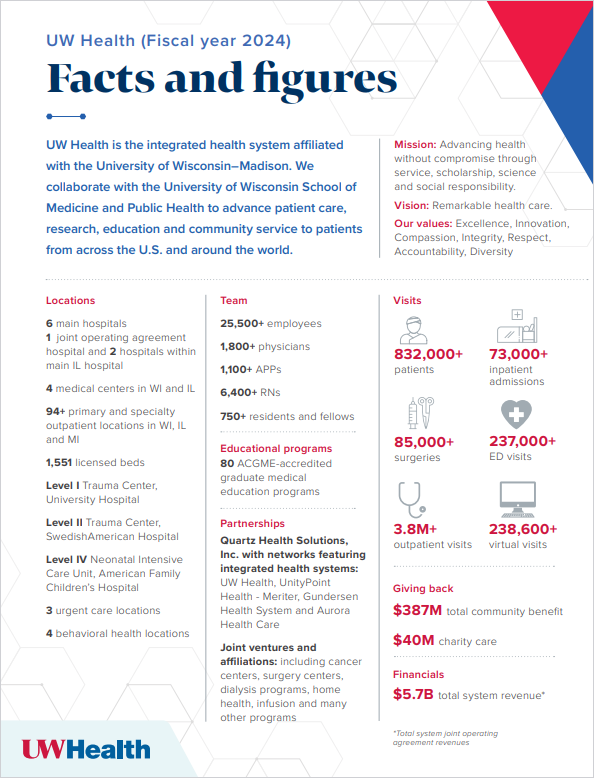 UW Hospitals, which includes University Hospital on the UW–Madison campus and UW Health East Madison Hospital on the east side of Madison, has been ranked No. 1 in Wisconsin for 14 years in a row by U.S. News and World Report.
Pediatric experts at UW Health Kids have served the special needs of children for more than 100 years, and our world-class American Family Children’s Hospital is a comprehensive pediatric medical and surgical center featuring nationally recognized pediatric specialists in a wide range of fields. UW Health has been recognized by the Human Rights Campaign Foundation as a leader in healthcare equality, and the University of Wisconsin Hospitals and Clinics, East Madison Hospital and American Family Children’s Hospital are Magnet®-designated facilities, reflecting nursing excellence and quality patient care.
Our flagship emergency department is located at University Hospital, a 505-bed national referral center that is home to a Level One adult and pediatric trauma center, American College of Surgeons verified Burn Center, one of the nation’s largest organ transplant programs, one of the nation’s first certified comprehensive stroke centers and the UW Health | Carbone Cancer Center, one of 57 National Cancer Institute designated comprehensive cancer centers in the country.
For additional information on UW Health, visit uwhealth.org or read more facts & figures about the UW Health system.
Founded in 1907, the University of Wisconsin School of Medicine and Public Health (SMPH) is recognized nationally and internationally for excellence in education, research, and service. In 2005, it became the nation’s first fully integrated school of medicine and public health, reflecting a bold commitment to bringing medical science and public health together across all mission areas.
Today, SMPH advances health through a collaborative approach spanning clinical care, research, education, and community engagement. With more than 5,500 employees, including 2,000 faculty across 28 departments, the school has a strong statewide presence focused on discovery, innovation, and improving the health of people in Wisconsin and beyond.
Consistently ranked among the nation’s top medical schools, SMPH offers a full continuum of medical and public health education. Its faculty include some of the country’s leading educators, researchers, and clinicians, including National Medal of Science recipients and members of the National Academy of Sciences.
As a research leader, SMPH ranked 23rd among U.S. medical schools — and 9th among public medical schools — for NIH funding in fiscal year 24. The school received $622 million in research funding in 2023-24, constituting 37% of total grants awarded to the University of Wisconsin–Madison. Known for rapidly translating discoveries into practice, the school integrates research, patient care, and education to shape the future of health locally, nationally, and globally.
Learn more at med.wisc.edu.
 Since its founding in 1848, this campus has been a catalyst for the extraordinary. As a public land-grant university and major research institution, our students, staff, and faculty engage in a world-class education while solving real-world problems.
With a total annual budget of over $4.5 billion including more than $1.9 billion in annual research expenditures, UW–Madison has been in the top 10 in national research spending every year since 1972. The campus is home to more than 50,000 students across 13 schools and colleges with more than 25,000 faculty and staff. Members of the student body represent all 50 states and 124 countries. The university was ranked the number one public university Washington Monthly’s 2024 College Guide and Rankings and is ranked 13th among public institutions in U.S. News & World Report’s 2024-25 rankings of best colleges.
The Wisconsin Idea — the principle that the university should improve people’s lives beyond the classroom — has been guiding the efforts of UW–Madison Badgers for more than a century. The university is consistently ranked among the top large schools for producing Peace Corps volunteers and boasts 20 Nobel Prize winners among its faculty and alumni.
Explore more about the University of Wisconsin—Madison at wisc.edu.
The William S. Middleton Memorial Veterans Hospital and Clinics over 80,000 Veterans across 19 counties in Wisconsin and Illinois. The distinguished five-star VA medical center and teaching hospital provides primary care and specialty health services, including cardiology, emergency services, mental health care, treatment for post-traumatic stress disorder (PTSD), suicide prevention, women’s health services, and more.
Madison VA Hospital and Clinics are among the leading health care systems serving Veterans in the VA Great Lakes Network (VISN 12), which includes facilities in Wisconsin, Illinois, northwestern Indiana and the Upper Peninsula of Michigan. The VA Hospital is one of the few heart, lung, kidney, and liver transplant and LVAD programs within the VA, as well as a VA Geriatric Research Education and Clinical Center (GRECC). In 2022, it received the highest national award for patient experience among all VA medical centers in the United States, as well as a five-star rating for patient experience from the Centers for Medicare & Medicaid Services.
The Madison VA is physically contiguous with University Hospital and houses an 11-bed emergency department that provides care to 13,500 adult patients annually and is accredited as a Level 2 Geriatric Emergency Department by the American College of Emergency Physicians. Our faculty physicians provide 12 hours of attending physician coverage daily, and we partner with emergency medicine pharmacists, Women’s Health, Mental Health, critical care and palliative care services to provide comprehensive emergency care for Veterans.
Learn more at madison.va.gov.
“To improve the health of Wisconsin’s residents and beyond by training leaders in academic medicine, delivering remarkable health care, and performing impactful emergency care research.”
Our mission statement